
Chancel Window and Stonework 1786
In 1714, the original Radnor families met with the Reverend John Clubb who had come from London to be their missionary, sponsored by the Society of the Propagation of the Gospel in Foreign Parts. Rev. Clubb was promised “a handsome stone church” in gratitude. The church building was constructed in only one year using local fieldstone and oak timbers. The early parish members helped with the construction under the guidance of a master mason and carpenter. Tragically, Rev. Clubb died before the first celebratory Christmas service.
Great care can be seen in the dressing and laying of the stone courses as the rough stones had to be squared and shaped by hand. Limestone from the Great Valley was quarried and burned to make lime for the mortar. Local oak trees were cut and hewn for the rafters. Folklore in the area includes a story that original leaded windows were removed by Washington’s army and the lead was melted into musket balls after the Battle of Brandywine and during the Radnor Piquet 1777-1778. The large chancel window on the east side of the church was installed in 1786 and replaced an original smaller window.
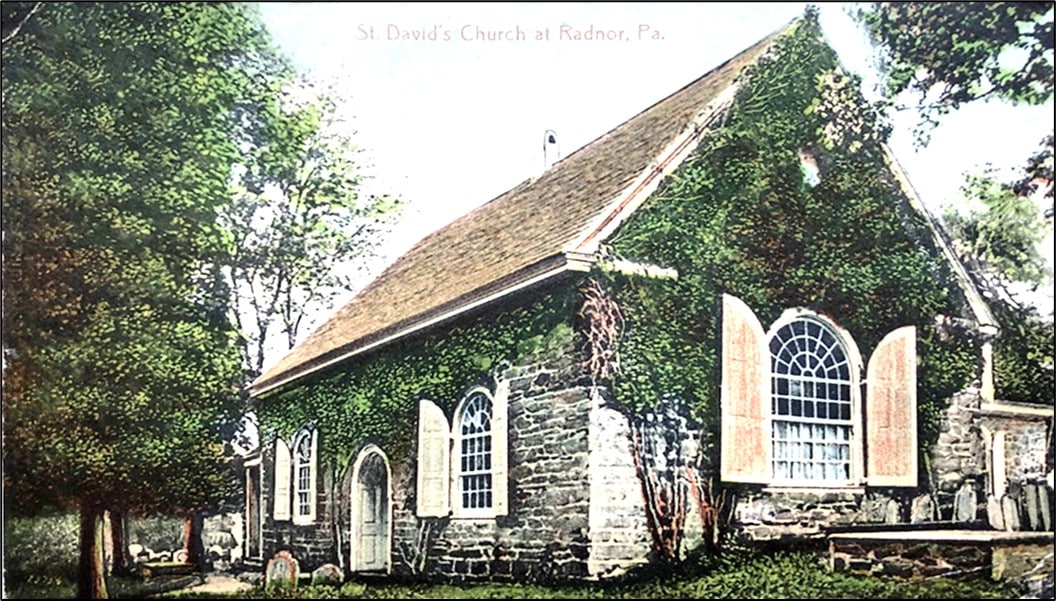
Victorian, hand colored penny postcard photographed and published by Philip H. Moore
